
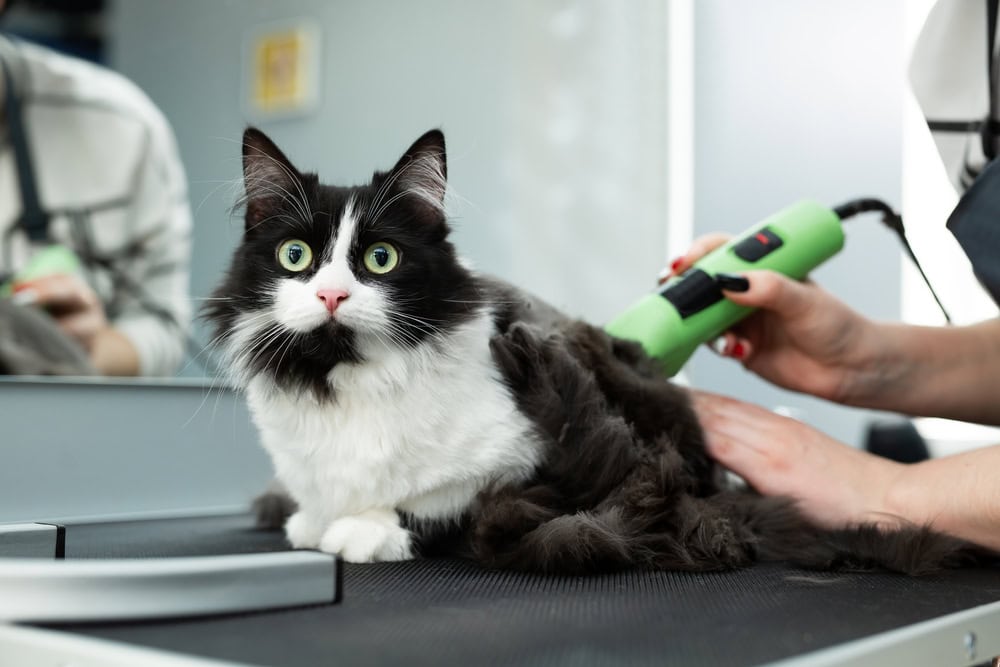
Why Regular Cat Grooming Matters in the UAE
Mat-shaved Persians, ingrown nails, and impacted ear wax — most cat skin problems we see at Soaptopia are preventable with a 30-minute maintenance groom every four to six weeks. The cats that need a full shave-down under sedation almost never got there overnight. They got there over a year of “she grooms herself.”
The Myth That Costs UAE Cat Owners the Most
Cats do groom themselves. A healthy, young, short-haired cat with a normal body condition can largely manage its own coat, and it will spend a serious portion of its waking life doing exactly that.
The trouble is that the sentence gets applied to cats it was never true for:
- Long-haired breeds. A Persian, Himalayan, Maine Coon, Ragdoll or Norwegian Forest Cat carries a coat that a tongue cannot maintain. The undercoat compacts faster than the cat can process it — and everything it does manage to swallow comes back as hairballs.
- Overweight cats. A cat that can’t twist far enough to reach its lower back and hindquarters stops grooming precisely the areas that mat first. Those mats then make movement uncomfortable, the cat moves less, and the problem accelerates.
- Senior and arthritic cats. Same mechanism, different cause. A stiff, sore cat quietly gives up on the hard-to-reach areas, and the coat over the spine and hips goes first.
- Any cat that is already in pain. Reduced grooming is one of the earliest signs owners miss.
Why UAE Homes Make It Worse
The AC Never Stops
Indoor cats here live in stable temperature and artificial light all year. That removes the seasonal cue that drives a normal moult — so instead of two big sheds, many cats here shed steadily, year-round. More loose hair in the coat, all the time, means more matting and more hairballs.
Dry Air, Dry Skin
Air conditioning strips humidity. Dry skin flakes, itches and sheds more, and a cat that over-grooms an itchy patch can strip the fur off it entirely.
Dust and Sand
Fine dust settles into a long coat and works like grit between the hairs. It’s a matting accelerator, especially in the armpits, the ruff and the britches.
Indoor-Only Cats Don’t File Their Own Nails
Nails are worn down by climbing and rough surfaces. A cat living entirely on tile, rugs and a scratching post — especially an older, less active one — keeps growing nail that never wears. The nail curls, and the tip eventually grows into the pad. That is a painful, infected, entirely preventable injury we see far too often.
What “Skipping It” Actually Costs
1. Matting Turns Into a Medical Problem
A mat is not a tangle. It’s a solid, contracting knot of hair anchored to the skin, and it keeps tightening. As it does, it pulls on the skin from every direction. Underneath a serious mat you find red, inflamed, sometimes broken skin, and because it’s sealed off from air, whatever is growing under there stays warm and damp. Cats with heavy matting move stiffly, sleep badly, snap when touched and often stop grooming altogether — which makes the coat worse.
Past a certain point, a mat can’t be brushed out humanely. The only option is to clip it out, and if the mats cover most of the body — a mat-shaved Persian in a lion cut is a familiar sight in Dubai — that’s a long, uncomfortable job that sometimes has to happen at a clinic under sedation.
2. Ingrown Nails
Curled nails snag on fabric, tear, and grow into the pad. The cat limps, licks the paw, and the wound gets infected. Treatment means a vet visit, often sedation, and antibiotics. Prevention means a nail trim every three to four weeks.
3. Impacted Ear Wax
Flat-faced breeds and heavily coated ears accumulate wax that the cat can’t clear. Impacted wax is uncomfortable, it traps debris, and it hides the early signs of ear mites and infection — head-shaking, scratching, a dark discharge or a smell.
4. Everything You Don’t See
The most underrated part of a professional groom is that someone puts their hands on every part of your cat every few weeks. Lumps, scabs, fleas, wounds, weight changes and sore joints get found on the grooming table long before they’d get found on the sofa.
The Maths, Plainly
| Staying on Top of It | Letting It Go | |
|---|---|---|
| What Happens | A 30-minute maintenance groom every 4–6 weeks: bath, thorough dry, deshed and comb-out, nails trimmed and filed, ears cleaned, sanitary trim. | Full-body dematting or a shave-down, sometimes at a clinic under sedation, plus treatment for whatever was hiding underneath. |
| Cost | The price of a standard cat groom. | Vet consultation + sedation + clip-out + medication — several times the cost of a routine groom, and repeated if it happens again. |
| Your Cat’s Day | Half an hour at home, in a van at your door. | A carrier, a car, a clinic, an anaesthetic and a recovery. |
| Risk | Essentially none. | Sedation always carries risk — more so for seniors and cats with heart or kidney disease. |
| The Coat Afterwards | Healthy, and it stays that way. | Shaved to the skin, followed by 3–6 months of regrowth. |
The One Thing You Must Never Do at Home
Do not take scissors to a mat. This is the most common cause of the cat lacerations groomers and vets see. Cat skin is thin, loose and mobile, and a tight mat pulls it up into a tent — so the skin sits inside the mat, not below it. You cannot see where the mat stops and the cat starts. People are certain they were nowhere near the skin, and then there’s a wound that needs stitches.
If a mat won’t come out with a metal comb and gentle work, stop and call a groomer. Clippers, used flat against the skin by someone who does it every day, are the safe tool.
The 30-Minute Rule: How Often, by Cat
| Cat | Professional Groom | Nails | Home Routine |
|---|---|---|---|
| Short-haired, young, active | Every 6–8 weeks | Every 3–4 weeks | Weekly brush; a rubber grooming mitt is usually enough. |
| Long-haired (Persian, Himalayan, Maine Coon, Ragdoll) | Every 4–6 weeks | Every 3–4 weeks | 5 minutes daily with a metal comb — not just a slicker. |
| Overweight, senior or arthritic | Every 4 weeks | Every 3 weeks | Daily check of the lower back, hips and tail base. |
The Six Places Mats Form First
Check these, in this order, every few days: behind the ears, the ruff around the neck and under the collar, the armpits, the belly, the britches (the trousers at the back of the hind legs), and the base of the tail. A coat can look immaculate from above and be solid underneath.
How to Make Home Combing Work
- Use a metal comb, and work through to the skin. A slicker over the top of the coat only grooms the top of the coat.
- Short and often beats long and rare. Two minutes, three times a day, beats a twenty-minute wrestling match on Sunday.
- Stop before your cat asks you to. End the session while it’s still going well and the next one will be easier.
- Pair it with something good — food, a treat, the sunny spot by the window.
- Start kittens early. A cat that’s been handled since it was twelve weeks old is a completely different animal on the table at ten years old.
See a Vet, Not a Groomer, If You Notice
- Broken, weeping or bleeding skin under a mat.
- Head-shaking, ear scratching, dark discharge or a smell from the ear.
- Limping, or licking one paw persistently.
- Sudden over-grooming, bald patches, or scabs along the back and belly — often allergy, parasites or pain rather than a coat problem.
- A cat that has stopped grooming itself at all.
We’ll always tell you when something needs a vet before it needs a groomer.
Cat Grooming, Without the Carrier
Almost everything a cat hates about grooming happens before the grooming starts: the carrier, the car, the waiting room, the barking. We remove all of it. Our climate-controlled van parks at your door, one groomer works with your cat alone, and your cat is back inside its own home within the hour.
We’ve been grooming cats in Dubai since 2015 — Persians, Bengals, Maine Coons, rescues and cranky seniors included. Every package includes nail trimming and filing, ear cleaning, and cat-specific grooming products rather than dog shampoo. We’ll also be honest about what your cat’s coat actually needs.
Dog in the house as well? Here’s the grooming rhythm we recommend through a Dubai summer.
Frequently Asked Questions
Do Cats Really Need Professional Grooming?
Short-haired cats often manage well with a weekly brush and a regular nail trim. Long-haired cats, overweight cats and senior cats do not — for them, professional grooming is preventive healthcare, not a luxury.
How Often Should a Persian Cat Be Groomed?
Every four to six weeks professionally, with a few minutes of combing at home most days. Persians mat quickly, and their ears and tear-staining need regular attention.
Can a Matted Cat Be Brushed Out Instead of Shaved?
Sometimes, if the matting is caught early and is confined to a few areas. Once mats are tight and widespread, dematting is painful and slow, and a clip-out is the kinder option. We’ll tell you which situation you’re in before we start.
Is It Safe to Bathe a Cat?
Yes, when it’s done by someone who knows how to handle cats, with a cat-specific product and a proper dry afterwards. A damp cat left to dry itself in an air-conditioned room is genuinely miserable.
My Cat Hates Being Handled. Can You Still Groom Her?
Often, yes — a lot of that hatred is really about the carrier and the car, and both disappear with a mobile groom. Tell us about her before the appointment so we plan for it. If she’s genuinely too distressed to continue, we stop, and we say so.
Book Your Cat In Before the Coat Decides for You
If you’re finding small knots behind the ears, or you haven’t looked at your cat’s belly in a while, this is the cheap week to deal with it.
Book a mobile cat groom — or call +971 50 939 7039 and describe the coat. We’ll tell you what it needs.

